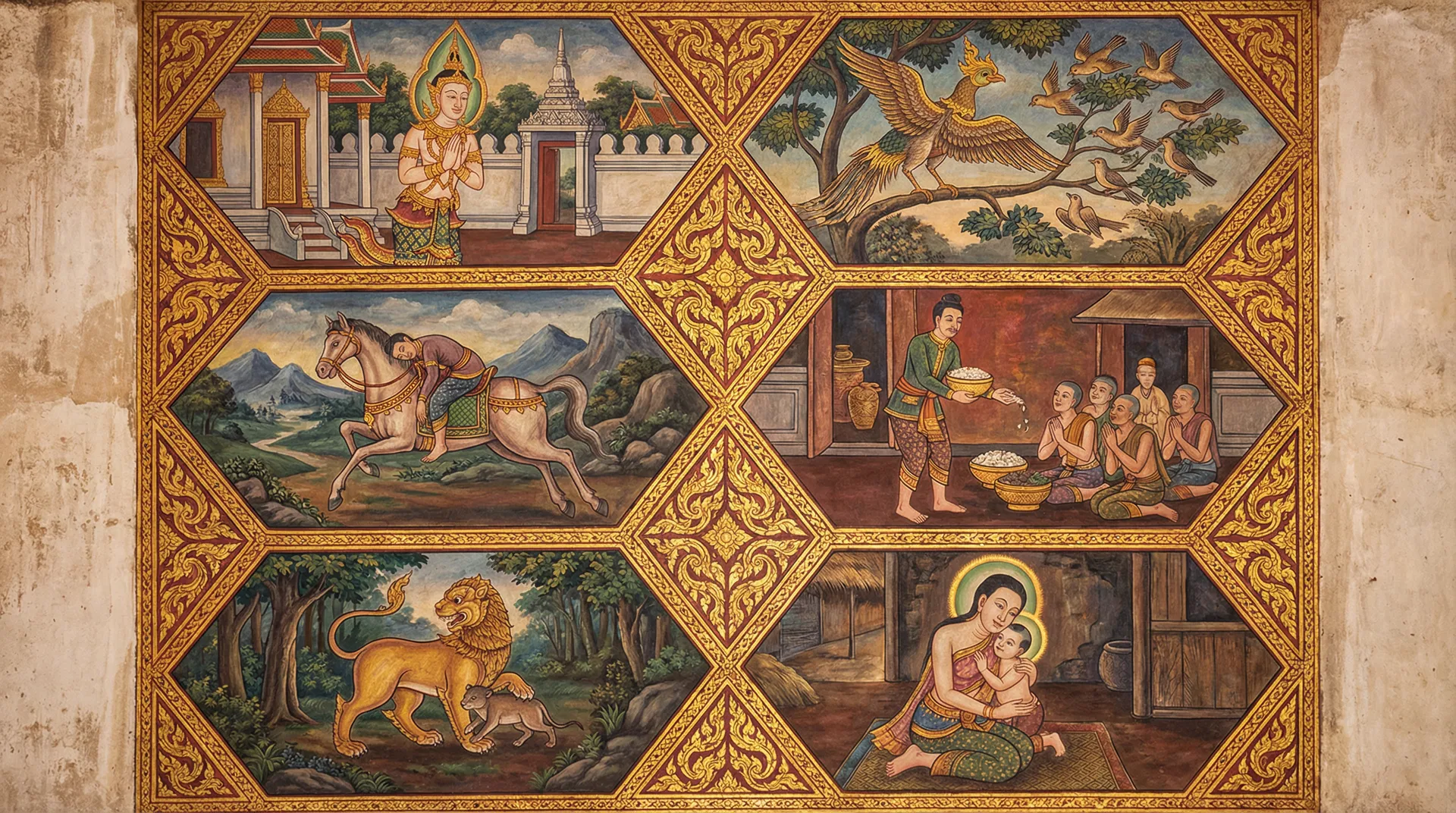
Sutasoma Jātaka
Sutasoma Jātaka
Long ago, in the vibrant city of Indapatta, ruled a king named Piliya, a monarch whose heart was as generous as his kingdom was bountiful. His reign was a golden age, marked by peace, prosperity, and the unwavering devotion of his subjects. Yet, even in such a land of plenty, the whispers of ambition could be heard, particularly from the hearts of those who craved power beyond their station.
In a neighbouring kingdom, known for its warrior spirit and its proud traditions, lived a formidable king named Kamsa. Kamsa was a ruler consumed by a singular, unyielding ambition: to conquer and rule all the lands surrounding his own. His eyes, sharp as a hawk's, were set upon Indapatta, its wealth and its strategic location a tempting prize. He gathered his armies, his banners unfurled like thunderclouds, and marched towards King Piliya's domain.
King Piliya, though a man of peace, was not one to shy away from defending his people. He called upon his loyal warriors, men of courage and skill, to prepare for the inevitable conflict. However, he was also a king who understood the devastating cost of war, the tears shed by widows, and the orphaned children left behind. He sought a path that would avoid bloodshed, a solution that would satisfy Kamsa's ambition without plunging his kingdom into ruin.
It was then that the Bodhisatta, in his past life, was born as Prince Sutasoma, the virtuous and valiant son of King Piliya. Prince Sutasoma was renowned not only for his princely bearing and his martial prowess but also for his profound compassion and his unwavering commitment to non-violence. He possessed a keen intellect and a deep understanding of human nature, seeing the underlying desires and fears that drove even the most aggressive of men.
As Kamsa's army approached the borders of Indapatta, Prince Sutasoma, with a heavy heart but a resolute spirit, made a bold proposal to his father. "Father," he said, his voice calm and steady, "I have a plan to avert this war. King Kamsa seeks glory and dominance. Let me face him, not on the battlefield, but through a contest of strength and courage. I will offer myself as a prize, a testament to my kingdom's valor. If I am defeated, Kamsa may claim me, and with me, perhaps, a measure of his desire for conquest. But if I prevail, his ambition will be tempered, and peace will be restored."
King Piliya, torn between paternal love and the well-being of his kingdom, was deeply troubled. "My son," he implored, "this is a perilous path. Kamsa is a ruthless warrior. I cannot bear the thought of you facing such a danger."
Prince Sutasoma, however, remained steadfast. "Father," he replied, "true courage lies not in avoiding danger, but in facing it with wisdom and compassion. I believe that through this trial, we can achieve a lasting peace, free from the ravages of war. I am willing to lay down my life if it means saving thousands of others."
Understanding his son's unwavering conviction and his noble intentions, King Piliya, with a heavy heart, granted his consent. News of Prince Sutasoma's offer reached King Kamsa, who, intrigued by the audacity of the proposal, readily agreed. He saw it as an opportunity to humiliate King Piliya and seize a valuable prize without the costly effort of a full-scale invasion.
The contest was arranged. Prince Sutasoma, adorned in simple, unadorned armor, met King Kamsa on a vast plain between the two kingdoms. The air was thick with anticipation, the armies of both sides watching in silent awe. Kamsa, a hulking figure of brute strength, sneered at the prince. "You dare to offer yourself as a pawn in my game, young prince? Your father must be desperate indeed."
Prince Sutasoma, with a gentle smile, replied, "King Kamsa, I offer not myself as a pawn, but as an embodiment of my kingdom's spirit. Let our contest decide the fate of our peoples, not through bloodshed, but through a demonstration of strength and resolve."
The combat began. Kamsa fought with a ferocity born of aggression, his blows powerful and relentless. Prince Sutasoma, however, moved with an almost divine grace. He met each of Kamsa's attacks not with brute force, but with skillful deflection and precise counter-strikes. He used Kamsa's own strength against him, evading his charges and redirecting his momentum. It was a dance of power and precision, a testament to the prince's superior training and his calm demeanor.
As the battle raged, Prince Sutasoma saw an opening. With a swift, decisive movement, he disarmed Kamsa, his sword clattering uselessly to the ground. Kamsa, stunned and humiliated, stood defenseless before the prince. The crowd gasped, expecting the prince to strike the final blow, to end the contest with Kamsa's life.
But Prince Sutasoma did not raise his sword in anger. Instead, he lowered it, his gaze filled with compassion. "King Kamsa," he said, his voice resonating with a newfound authority, "you have fought bravely, but your heart is consumed by pride and a lust for power. Today, you have seen that true strength lies not in conquest, but in restraint and wisdom. I could end your life now, but that would only sow seeds of further hatred and conflict. Instead, I offer you a choice: return to your kingdom, abandon your ambitions of conquest, and live in peace. Or, if you persist in your destructive path, you will face the consequences of your own actions."
Kamsa, humbled by the prince's mercy and awed by his skill, was deeply moved. He saw the futility of his quest for dominance and the wisdom in Sutasoma's words. He bowed his head, his arrogance replaced by a profound respect. "Prince Sutasoma," he said, his voice rough with emotion, "you have shown me a greater strength than I have ever known. Your mercy is more potent than any weapon. I have been a fool, blinded by ambition. I pledge to you, and to your father, that I will trouble your kingdoms no more. I will return to my land and rule with a newfound understanding."
And so, a great war was averted. Prince Sutasoma, the Bodhisatta, had not only saved his kingdom from destruction but had also transformed the heart of a conqueror. King Kamsa, true to his word, returned to his kingdom and became a just ruler, his days of aggression replaced by a commitment to peace. The story of Prince Sutasoma and his compassionate victory spread far and wide, becoming a legendary tale of how wisdom, courage, and mercy can triumph over brute force and destructive ambition.
The people of Indapatta rejoiced, their hearts filled with gratitude for their valiant prince. King Piliya, his eyes shining with pride and relief, embraced his son, knowing that the future of his kingdom was secure in the hands of such a virtuous leader. The Sutasoma Jātaka stands as an enduring testament to the fact that true victory is not found in vanquishing an enemy, but in transforming them, and that the greatest strength lies in the power of compassion and understanding.
— In-Article Ad —
💡Moral of the Story
True victory is achieved not through violence and conquest, but through wisdom, compassion, and the ability to show mercy.
Perfection: Compassion (Karuna)
— Ad Space (728x90) —
More Jataka Tales You May Enjoy
 113Ekanipāta
Mahāgovinda Sutta Jātaka
Mahāgovinda Sutta Jātaka In the opulent city of Varanasi, a kingdom blessed with peace and prosperit...
💡 True wisdom lies in maintaining balance and equanimity in the face of both pleasure and adversity. Integrity and unwavering loyalty are the foundations of trust.
120EkanipātaSibi Jataka
Sibi Jataka In the ancient kingdom of Sibi, nestled amidst fertile plains and blessed with bountiful...
💡 The highest form of compassion and truthfulness involves selfless sacrifice for the well-being of others. True virtue transcends natural laws and personal comfort, earning immeasurable merit and inspiring all.
 349Catukkanipāta
Suvaṇṇamriga Jātaka
The Golden Deer JātakaIn a kingdom blessed with abundant forests and sparkling rivers, there lived a...
💡 True beauty and wisdom are to be appreciated and understood, not possessed. Righteous rule and compassion are cultivated through learning from virtuous beings, even if they appear in humble forms.
 217Dukanipāta
Kusa Jataka
Kusa JatakaIn the ancient kingdom of Mithila, ruled a just and benevolent king, whose reign was mark...
💡 True love, unwavering determination, and compassion can overcome even the greatest of obstacles. Facing challenges with wisdom and kindness is a path to success.
14EkanipātaThe Bodhisatta as a Hunter
The Bodhisatta as a HunterIn the dense, untamed wilderness of the Himalayas, where snow-capped peaks...
💡 True compassion transcends self-preservation, and great sacrifices bring immeasurable blessings.
86EkanipātaThe Great Vanga Jataka
Once upon a time, in the glorious city of Savatthi, while the Supreme Buddha resided at Jetavana Mon...
💡 True compassion lies in the willingness to sacrifice one's own well-being for the benefit of others, and such selfless acts can bring about miraculous positive change.
— Multiplex Ad —